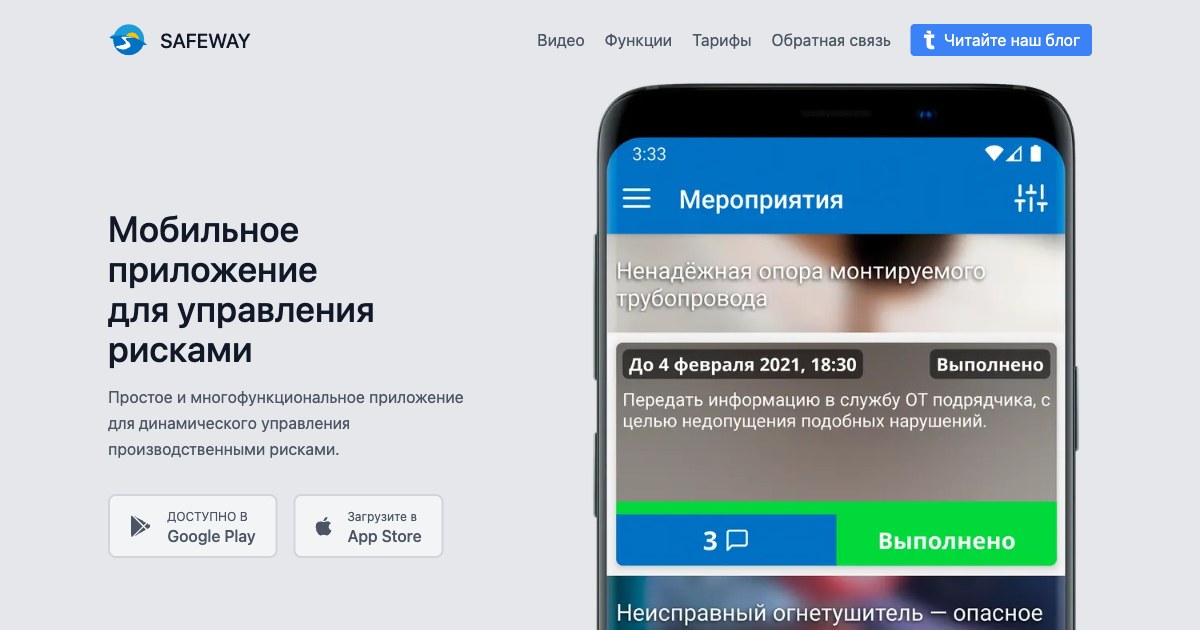
Live site: safeway.app
Stack (v1): Python · Flask · SQLAlchemy · PostgreSQL · React Native (Expo) · Redux · redux-offline · Sentry
What it solves
Industrial workplaces — factories, construction sites, warehouses — file safety incidents on paper. The forms are slow, the data isn’t analyzable, and supervisors find out about a hazard hours after a worker spotted it. SafeWay digitizes the issue → event → report flow on mobile, with an offline-first capture path (workers in production halls often have unreliable signal) and a web admin for supervisors and HSE officers.
Founder context
I founded SafeWay in 2019 and ran it solo for two years — backend, mobile, landing, App Store and Play Store submissions, sales calls, in-field focus groups inside actual industrial sites. The product launched in production in 2021 and has been running ever since with paying customers on free, lite, and pro tiers.
Architecture (v1)
Backend is a Flask + SQLAlchemy modular app split into auth, companies, units, issues, events, reports, chat. Postgres, gunicorn, Sentry from day one, mailgun for transactional email, JWT via Flask-JWT-Extended, Pillow for image processing, alembic for migrations. The mobile app is React Native on Expo SDK 41 with Redux + redux-offline — the offline-first piece is the most important technical decision in the project, because workers cannot retry uploads manually when their signal flakes. Push notifications go through expo-server-sdk; barcode scanning, camera, and geolocation use Expo modules. The landing page is Next.js + Tailwind on Vercel.
What’s next
After 4 years in production, I’m rewriting the mobile app in Flutter with a Django-Ninja backend — same domain, modernized stack, lessons from running v1 baked in. A detailed writeup is coming when v2 ships.
What I learned
Three things I’d tell my 2019 self. One: offline-first is harder than the redux-offline README implies — optimistic UI with retry-on-reconnect needs a per-action conflict resolution policy, not a one-size-fits-all queue. Two: Expo’s managed workflow is a fast start but a tight ceiling — every time I needed a native lib, I had to drop to bare workflow, and that toggle is more painful than just starting bare. Three: Sentry on day one for both crashes and breadcrumbs is non-negotiable for solo SaaS — when you’re debugging an incident at 3am with no on-call, the breadcrumb trail is the only thing standing between you and a full revert.